We are going to start with article with a little ruthlessness, because we feel its necessary if you are reading this.
Most SaaS founders treat compliance like a side quest.
They just think of it like a regular boring paperwork, something that they can figure out once they grow.
But to be very honest, that mindset is trash. This mindset of treating compliance optional kills more deals than the actual competitors.
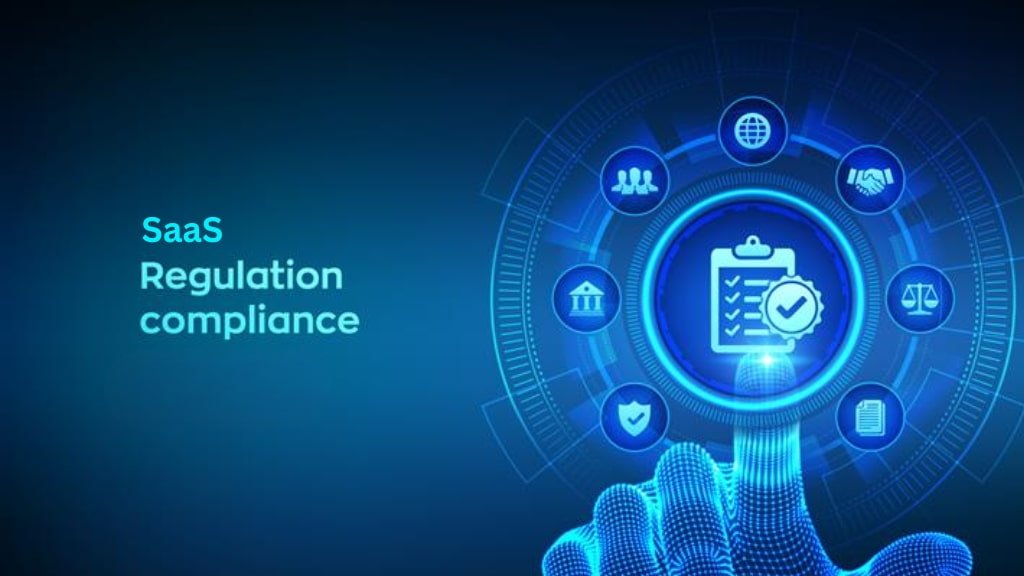
If you’re building a SaaS product today, saas compliance is not optional.
It should be part of the product, scaling and credibility.
Without compliance, your pipeline will look like “We’ll get back to you”.
And in this guide, we are going to walk you through everything you should know about compliance as founder.
Why SaaS Compliance Matters More Than You Think
Every SaaS handles user data in some form.
And the moment that happens, you are responsible for handling the risk and expectations from users to keep it safe.
Small businesses might trust you but mid sized and enterprise won’t unless you prove that you are following SaaS data security standards.
This isn’t about fear. This is about growth.
Compliance will accelerate trust in your SaaS and that trust will convert into more deals.
When you integrate saas compliance into your early foundation, you are unlocking big customer segments that you can target.
And in reality, you are actually putting your competitors behind you as most SaaS businesses don’t involve compliance in the very beginning.
The Core Pillars of SaaS Compliance You Need to Master
Compliance looks huge from the outside, but if you break it down into four buckets, it becomes easy to navigate:
1. Security Controls
This includes encryption, access management, monitoring, backups, the basics that align with saas data security standards.
2. Privacy Requirements
This covers how you collect, store, process, and delete personal data across regions.
3. Operational Consistency
Policies, documentation, onboarding and offboarding, incident management.
4. Certification & External Audits
Like soc2 saas, ISO certifications, or industry-specific frameworks.
Once you understand these buckets, compliance stops feeling overwhelming.
Let’s Break Down Every Major Compliance Requirement You Should Know
1. SOC 2: The Golden Ticket for SaaS
Almost every SaaS founder eventually hears the words “Do you have SOC 2?”
This is the moment where half the founders panic.
A soc2 saas audit checks how strong and consistent your internal controls are across five areas:
- Security
- Availability
- Processing integrity
- Confidentiality
- Privacy
If you want enterprise customers, start preparing for SOC 2 early. Even if you don’t audit immediately, aligning your operations with SOC 2 signals maturity, discipline, and reliability.
soc2 saas compliance also overlaps with many other standards, which makes life easier later.
2. ISO 27001: The International Standard
Think of ISO 27001 as a global blueprint for building an Information Security Management System (ISMS).
It aligns with saas security compliance and adds structure that SOC 2 doesn’t enforce.
ISO 27001 includes:
- Risk assessment
- Asset management
- Access controls
- Supplier relationships
- Operational security
- Cryptography controls
- Logging and monitoring
If you expand globally, this certification makes you look serious.
3. GDPR: If You Have EU Users, This Is Non-Negotiable
GDPR isn’t just a privacy law, it’s a culture of responsibility around data.
If you serve EU customers, GDPR is part of your saas compliance whether you like it or not.
Key requirements:
- Data mapping
- Lawful processing
- Consent management
- Data access rights
- Right to erasure
- Breach notification within 72 hours
- Data Protection Impact Assessments
GDPR influences your product design, database architecture, and marketing flows.
4. CCPA: The California Data Protection Law
If you have US customers, especially in California, CCPA enters the chat.
It gives users rights over their personal data and requires your SaaS to:
- Provide access to collected data
- Allow deletion requests
- Provide opt-out mechanisms
- Disclose data usage clear
This fits directly into saas security compliance and saas data security standards because privacy is a security issue.
5. HIPAA: For Health-Related SaaS
If your SaaS even slightly touches healthcare or PHI (Protected Health Information), you need HIPAA.
Key rules:
- Privacy Rule
- Security Rule
- Breach Notification Rule
- Access controls
- Audit logs
- Secure PHI transmission
This is one of the strictest frameworks out there, but also one of the most valuable if you’re entering the healthcare industry.
6. PCI-DSS: If You Handle Credit Card Data
This applies if:
- You store card data
- Process payments
- Handle transactions via your backend
PCI-DSS requires:
- Network firewalls
- Strong encryption
- Strict access control
- Unique access IDs
- Monitoring and logging
- Regular security testing
- Physical security in hosting environments
Most SaaS products rely on Stripe to avoid this burden, but if your system interacts with card data directly even slightly,PCI-DSS becomes part of your saas compliance lifecycle.
7. Financial Compliance: IFRS, GAAP, ASC 606
These aren’t “security” standards, but they matter when:
- You recognize revenue
- You sell subscriptions
- You report financials
- You raise money
- You work with auditors
They define how you track revenue, expenses, and financial reports.
For SaaS businesses, accurate revenue recognition (ASC 606) is essential, especially when you offer annual plans, refunds, or multi-service bundles.
Now Let’s Match These With SaaS Data Security Standards
You can simplify saas data security standards into five core expectations:
1. Encrypt everything
At rest and in transit. No exceptions.
2. Minimize access
Limit who can touch what and keep logs.
3. Monitor continuously
Real-time alerts, logs, and anomaly tracking.
4. Run regular tests
Penetration testing, vulnerability scans, dependency checks.
5. Create repeatable processes
Consistent access reviews, onboarding/offboarding, and policy updates.
These practices make every other framework, SOC 2, ISO 27001, PCI-DSS, easier.
How SaaS Security Compliance Fits Into the Picture
Here’s where founders get the mental clarity they always wanted:
saas security compliance is the umbrella.
Every framework you’ve read about fits under that umbrella.
Security, privacy, and reporting all connect here.
To fully satisfy saas security compliance, you need:
- Secure infrastructure
- Consistent access governance
- Risk assessments
- Secure coding practices
- Incident response plans
- Vendor management
- Employee training
- Documented policies
- Technical safeguards
This is the backbone of your startup’s trust model.
How to Actually Implement Compliance Without Killing Productivity
Forget the giant checklists and the “enterprise” playbook.
Founders need something lean, practical, and achievable.
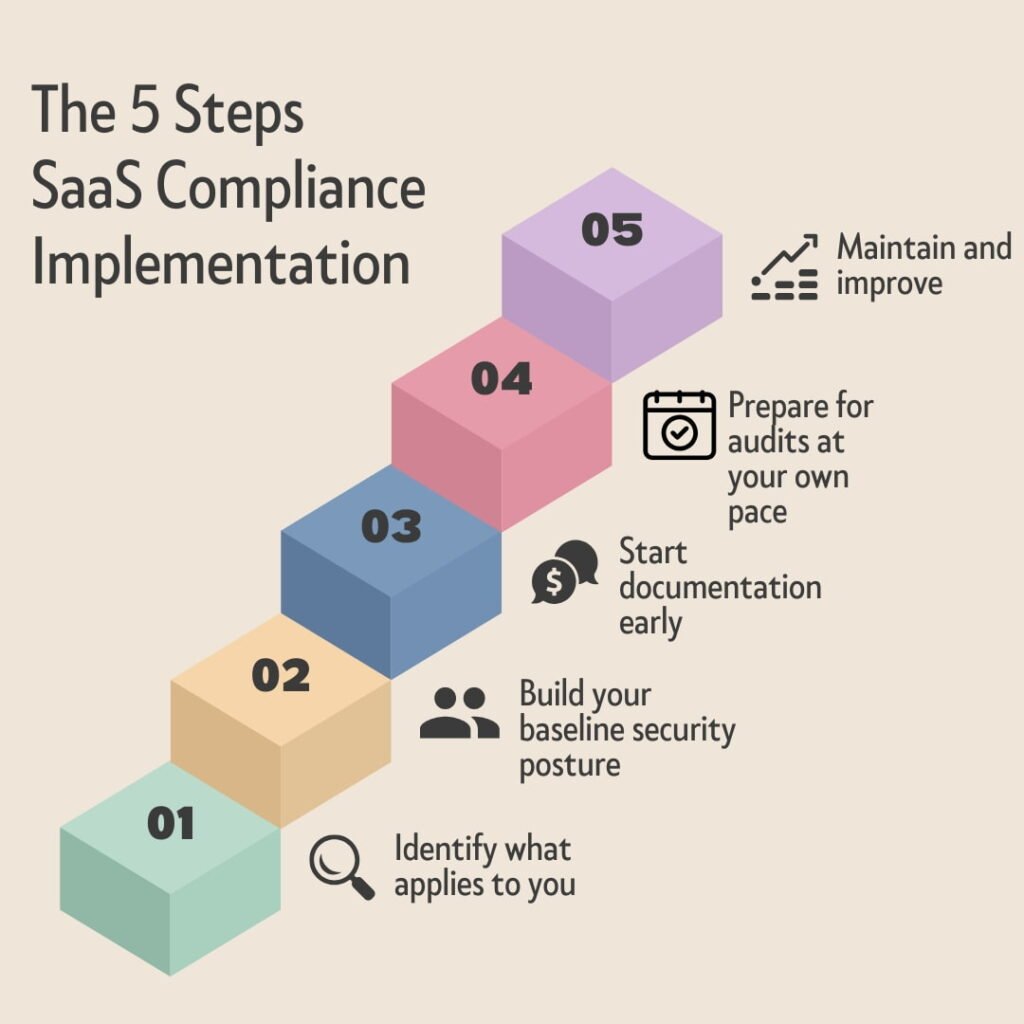
Here’s the roadmap:
Step 1: Identify what applies to you
For example:
- B2B enterprise SaaS → SOC 2 + ISO 27001
- EU users → GDPR
- US consumer base → CCPA
- Healthcare → HIPAA
- Payments → PCI-DSS
- Subscription model → ASC 606
Not every framework applies. Choose what matters today.
Step 2: Build your baseline security posture
This means aligning with saas data security standards:
- Strong encryption
- Zero-trust access
- Logging and monitoring
- MFA everywhere
- Secure cloud configuration
- Automated backups
Step 3: Start documentation early
Policies you should maintain:
- Access Control Policy
- Encryption Policy
- Vendor Management Policy
- Data Retention Policy
- Incident Response Plan
- Acceptable Use Policy
- Change Management Policy
Documentation is the heart of saas compliance.
If your team doesn’t write down the rules, nobody will follow them.
Step 4: Prepare for audits at your own pace
SOC 2 or ISO 27001 takes 2–6 months of preparation depending on your maturity.
If you don’t want to audit now, at least align your processes.
Even a “SOC 2 Ready” posture helps you pass enterprise security reviews faster.
Step 5: Maintain and improve
Compliance is not a one-time project.
You revisit your posture every quarter:
- Access review
- Logging review
- Vulnerability scan
- Policy update
- Vendor reassessment
This is how real SaaS companies operate.
SaaS Compliance Master Checklist (Founder Edition)
1. Identify Your Applicable Compliance Requirements
Check what applies to your business right now:
✔ SOC 2 (B2B SaaS or enterprise clients)
✔ ISO 27001 (global users or structured security needed)
✔ GDPR (EU users)
✔ CCPA (US/California users)
✔ HIPAA (health data or PHI involved)
✔ PCI-DSS (credit card processing in your system)
✔ IFRS/GAAP/ASC 606 (subscription revenue reporting)
✔ Vendor security reviews (if customers require assessments)
2. Core SaaS Data Security Standards
These are the basics every SaaS must follow:
✔ Data encrypted in transit (HTTPS/TLS)
✔ Data encrypted at rest (database storage encryption)
✔ MFA enabled for all employees
✔ Strong password policy enforced
✔ Zero-trust access: only minimum required access
✔ Logging enabled across servers/apps
✔ Real-time security alerts (failed logins, new admin users, unusual access)
✔ Backups configured and tested regularly
✔ Secure API authentication (OAuth, JWT, etc.)
✔ All dependencies regularly updated
3. Infrastructure & SaaS Security Compliance
Your backend infrastructure must meet basic saas security compliance expectations:
✔ Cloud hosting uses secure configurations
✔ IAM (Identity Access Management) roles managed properly
✔ Secure VPC/network structure
✔ Firewalls and WAF enabled
✔ Failover and redundancy in place
✔ Secrets stored in vault/secret manager
✔ Penetration testing scheduled (quarterly or semi-annual)
✔ Vulnerability scans automated
✔ Monitoring system for uptime and anomalies
✔ Disaster recovery plan tested
4. Product-Level Security Controls
Your SaaS app itself should follow strong controls:
✔ RBAC (Role-Based Access Control) implemented
✔ Input validation to prevent injection attacks
✔ Rate limiting to prevent API abuse
✔ Secure session handling
✔ Password hashing (bcrypt/argon2)
✔ Automatic logout/inactivity timeout
✔ Privacy-by-design architecture
✔ Data minimization (collect only what you need)
5. Organizational & People Compliance
This is where most startups fall apart. Fix it early:
✔ Company-wide security training
✔ Signed Acceptable Use Policy
✔ Signed Confidentiality/NDAs
✔ Employee onboarding checklist
✔ Employee offboarding checklist
✔ Laptop/device security (encryption + password)
✔ Remote work security policy
✔ Bring Your Own Device (BYOD) restrictions
✔ Shared password usage eliminated
6. Documentation Required for SaaS Compliance
You cannot achieve saas compliance without documentation:
✔ Access Control Policy
✔ Encryption Policy
✔ Password Policy
✔ Data Retention Policy
✔ Incident Response Plan
✔ Privacy Policy (public)
✔ Terms of Service (public)
✔ Vendor Management Policy
✔ Risk Assessment Report
✔ Change Management Policy
7. Privacy Compliance (GDPR + CCPA)
If you serve EU/US customers:
✔ Cookie consent banner
✔ Data mapping completed
✔ Clear lawful basis for data collection
✔ User rights page (access / delete / export data)
✔ “Do Not Sell My Data” mechanism (CCPA)
✔ Data retention deadlines documented
✔ Breach notification workflow
✔ Sub-processor list published
✔ DPA (Data Processing Agreement) available
8. SOC 2 Readiness Checklist
For soc2 saas preparation:
✔ Centralized logging and monitoring system
✔ Incident response plan tested
✔ Access review performed monthly
✔ Evidence collection automated
✔ Vendor risk assessments documented
✔ Change management tracked
✔ Policies reviewed every 6–12 months
✔ Asset inventory maintained
✔ Audit trail for all administrative actions
9. ISO 27001 Readiness Checklist
If you plan to pursue ISO:
✔ ISMS (Information Security Management System) created
✔ Scope of certification defined
✔ Risk assessment conducted
✔ Risk treatment plan created
✔ Annex A controls implemented
✔ ISMS effectiveness reviewed by management
✔ Internal audit scheduled
10. PCI-DSS Checklist (If You Handle Card Data)
✔ Firewalls configured
✔ Card data never stored in plain text
✔ Secure transmission of cardholder data
✔ Anti-virus installed and updated
✔ Access to card data strictly limited
✔ Unique IDs for each person with access
✔ Physical security for servers
✔ File integrity monitoring
11. HIPAA Checklist (If You Handle PHI)
✔ PHI encrypted
✔ Business Associate Agreements signed
✔ Audit controls implemented
✔ Access logs monitored
✔ Unique user identification
✔ Secure disposal of PHI
✔ Breach notification workflow
12. Ongoing Quarterly Review
Every quarter, review:
✔ Access logs
✔ Privileged roles
✔ Third-party vendors
✔ Security incidents
✔ Backup success/failure
✔ Policy updates
✔ Dependency vulnerabilities
✔ Cloud misconfiguration checks
13. Annual Review
Once a year:
✔ Penetration test
✔ Vendor contract evaluation
✔ Full security training refresh
✔ Incident response drill
✔ Compliance audit (internal or external)
The Founder’s Perspective: Why Compliance Gives You Leverage
Most founders think compliance slows them down.
But in reality, compliance is leverage.
Here’s why:
- It makes your SaaS look reliable
- It reduces legal and financial risk
- It accelerates enterprise sales cycles
- It builds long-term customer trust
- It helps you stand out against weak competitors
- It protects you against expensive breaches
- It makes your architecture future-proof
You don’t need to overbuild.
You just need to build with intention.
That’s the real meaning of saas compliance.
Final Thoughts
If you take one thing from this guide, let it be this:
SaaS compliance isn’t something you do when you’re “big enough.”
It’s something that makes your SaaS big enough.
When you follow saas data security standards, build discipline around saas security compliance, and prepare yourself for soc2 saas requirements early, scaling becomes smoother and sales become faster.
Founders who embrace compliance don’t just survive.
They close bigger deals, win higher-trust clients, and build companies that last.
FAQs
1. What is ISO compliance for SaaS?
ISO compliance means your SaaS is following the ISO 27001 standards for managing all information related to security. It proves that your customer data is protected with structured policies and monitoring systems.
2. What is SOC 2 compliance for SaaS?
SOC 2 checks if your SaaS follows strict security protocols, privacy controls, availability and confidentiality. It validates your internal processes like access rules and data protection practices.
3. Is SOC 2 equivalent to ISO 27001?
No, it is different. SOC 2 audits how well you operate security controls but on the other hand ISO 27001 checks your entire security management.
4. Why does SaaS compliance matter for founders?
SaaS compliance helps build trust, reduces risk of security and also helps with getting more enterprise sales as enterprise often require strict compliance.
5. What are the key elements of SaaS security compliance?
Key elements of every SaaS compliance includes encryption, logging, monitoring, employee training, secure coding, vendor checks, and access control.
6. Which compliance frameworks apply to most SaaS companies?
Most common frameworks that apply to most SaaS are SOC 2, ISO 27001, GDPR, CCPA, PCI-DSS, and HIPAA (if handling health data).
7. How do I start preparing my SaaS for compliance?
Start with the basic policies and build secure infrastructure. Also, implement encryption, access management and quality security checks. If you align early with SOC 2 or ISO 27001, it will help you avoid last minute chaos.